An AI speech coach you can practice with out loud
SayNow AI listens while you speak through a real situation, such as a team update, a toast or a tough question, answers back in conversation, then tells you what worked and what to fix on the next attempt.
- Spoken practice, not typing: you talk and the AI replies by voice
- 16 scenarios and 32 speaking frameworks to practice with
- Feedback on fluency, content structure, scenario fit and goal achievement
Free to download · iOS and Android
What an AI speech coach is
An AI speech coach is software that listens to you speak and gives you feedback on what you said and how you said it. It does the part of coaching that depends on repetition: you can run the same two-minute talk five times in a row, at 11 pm, without booking anyone's time.
It works from your words and your voice. That makes it good at some things and blind to others, and it is worth knowing which is which before you rely on it. An AI public speaking coach is a practice partner for the weeks between real audiences, and it sits alongside a human coach instead of replacing one.
What it can judge
Anything that shows up in what you say and how smoothly you say it.
- Structure: whether you opened with the point, whether the middle follows an order a listener can track, whether you closed or trailed off
- Clarity: vague phrases, sentences that restart twice, an answer that never reaches the question
- Fluency and pacing: long hesitations, rushing through the important line, stretches of filler
- Content: missing evidence, a claim with no example, a result with no number attached
- Fit: whether the tone and length suit the situation you chose, such as a 30-second introduction versus a 5-minute update
What it cannot judge
Things a person in the room would see and an app listening to your voice will not.
- Stage movement, posture and where you stand
- Gestures, facial expression and eye contact with an audience
- How your voice carries in a specific room or over a specific microphone
- Your slides and how you handle them
- How a live audience is reacting, and how well you adjust to it
- Whether your facts are correct: it hears what you claim, it does not check it
How a practice session works in SayNow AI
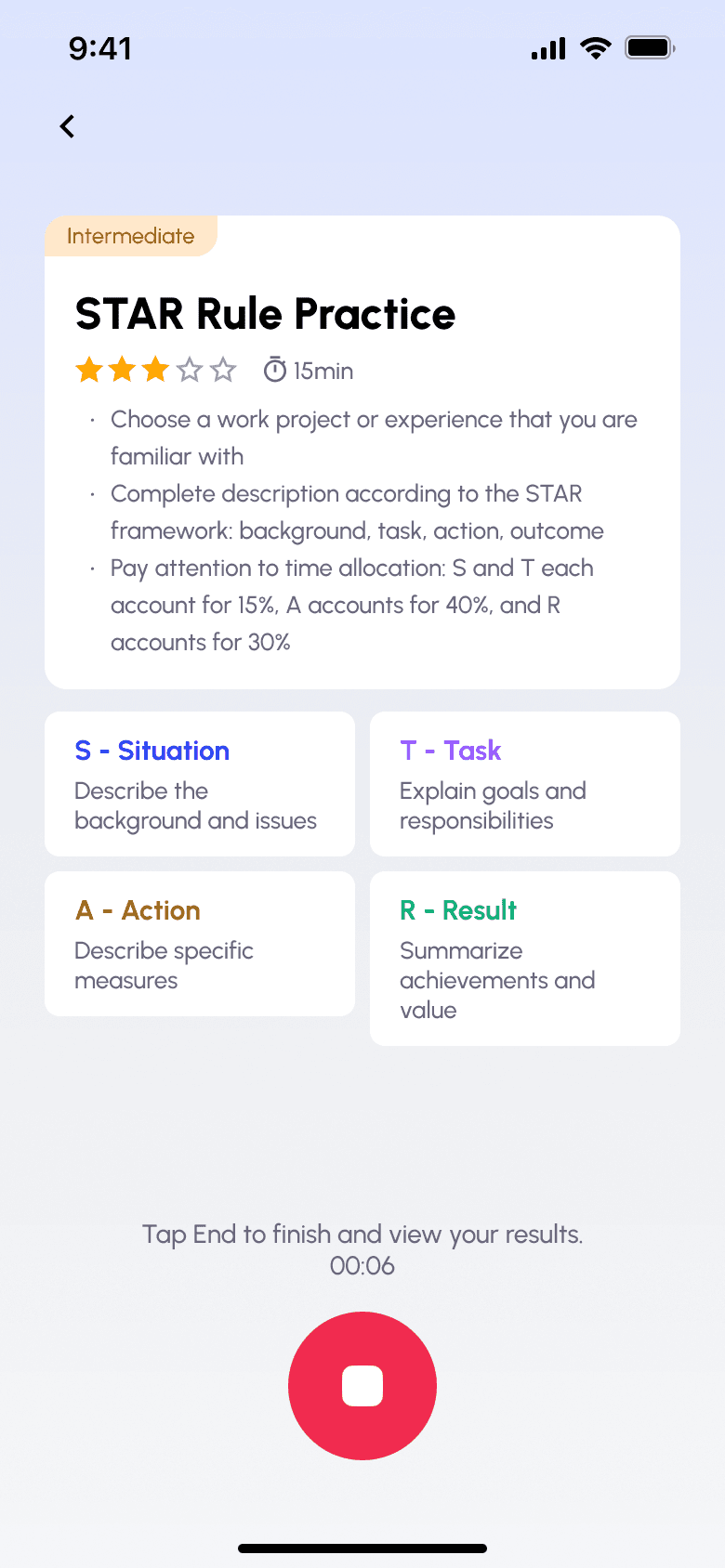
A session is one conversation. You do the talking, and the feedback arrives while the attempt is still fresh.
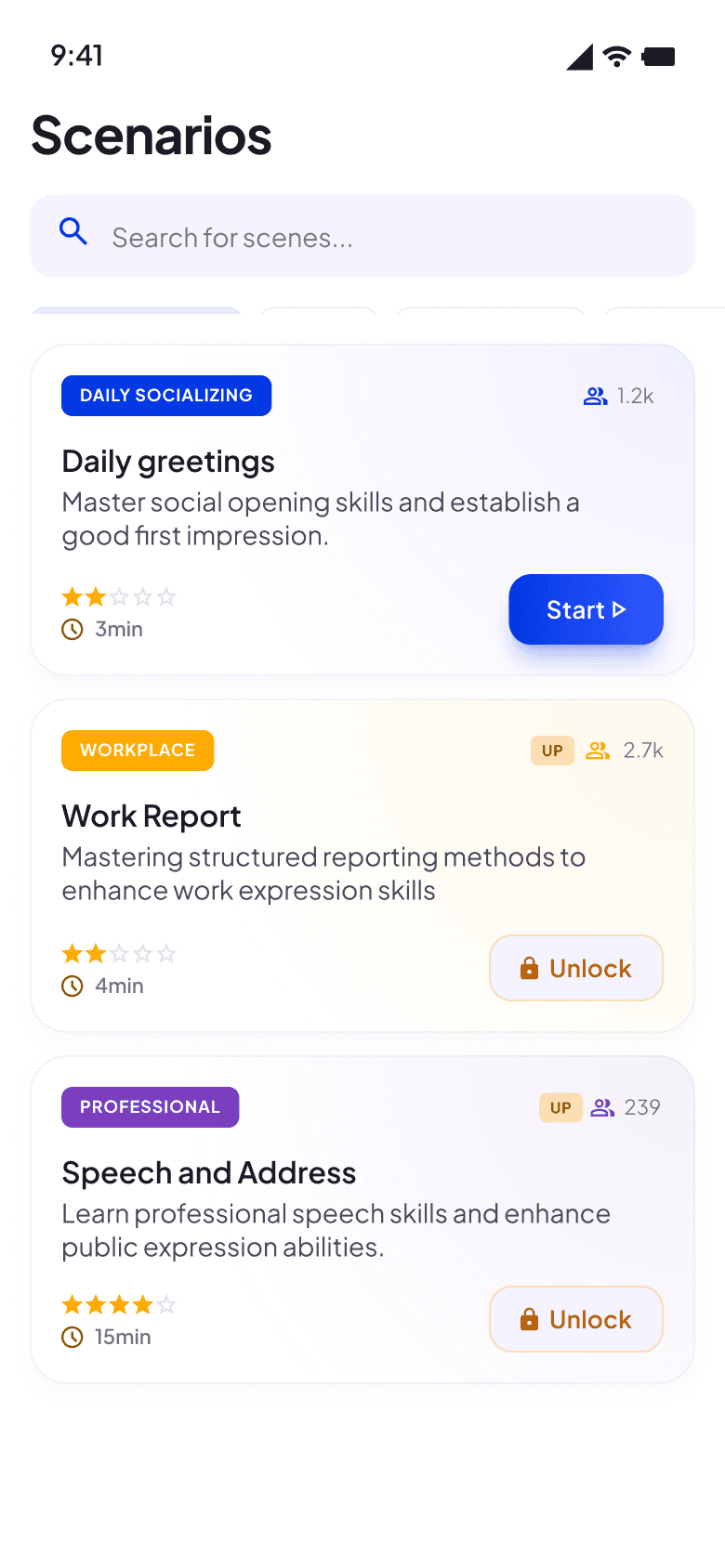
- 1Pick a scenario or a framework
- 2Speak
- 3The AI responds in conversation
- 4Read your score and suggestions
- 5Run it again
Pick a scenario or a framework
Choose a situation you have coming up, such as public speaking, a self-introduction or an impromptu answer. Or pick a structure you want to drill, such as PREP or the Pyramid Principle.
Speak
Say it out loud the way you would in the room. There is no script to read from, so you practice finding the words, which is the hard part.
The AI responds in conversation
The AI plays the other side: the audience member with a question, the manager who wants the short version. It replies by voice and you answer again, so the practice covers follow-ups and not only a prepared opening.
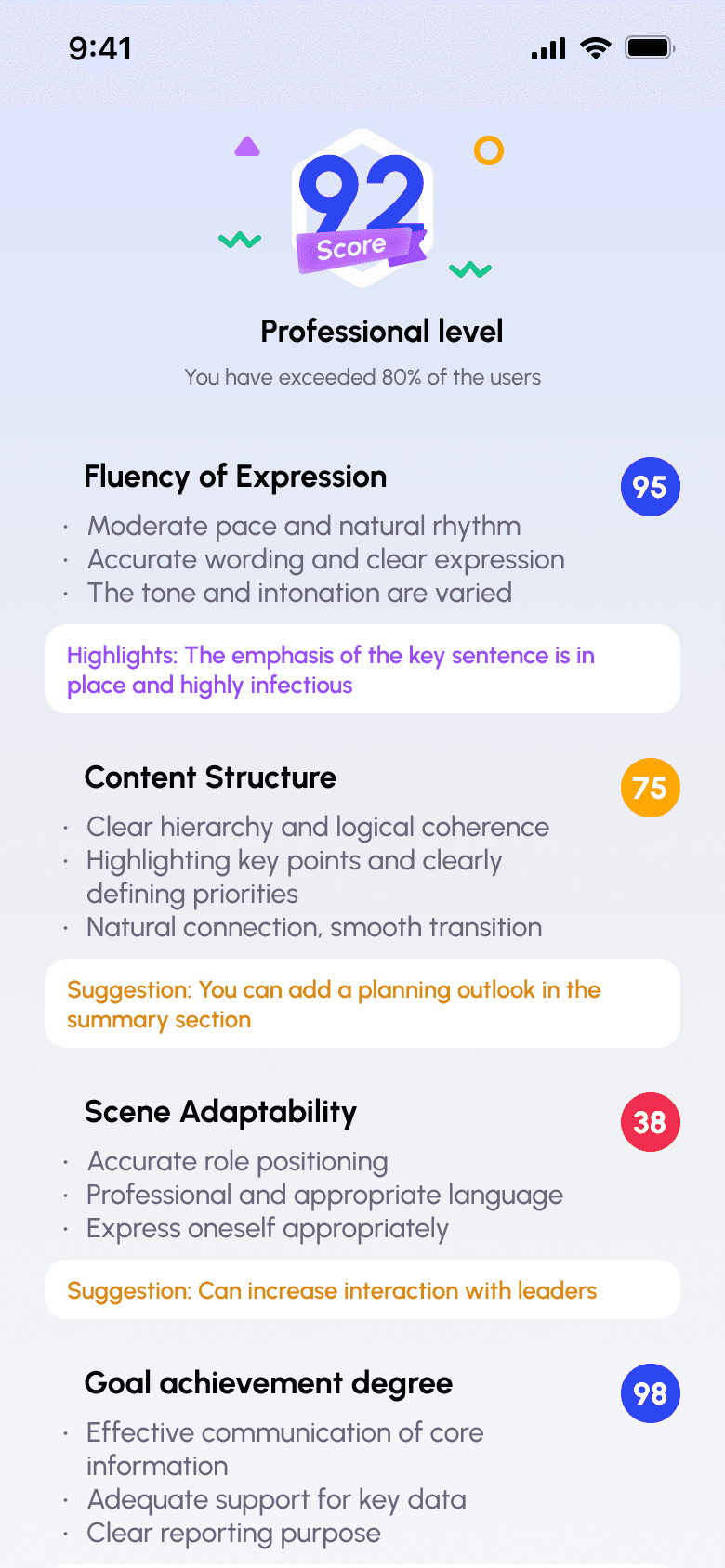
Read your score and suggestions
When the conversation ends you get a score and written suggestions across four areas, with pointers on what to change next time.
Run it again
Repeat the same scenario with one change in mind. Most of the improvement comes from the second and third attempt, not the first.
The four areas in your feedback
- Fluency
- How smoothly you got through it: hesitations, restarts and whether the pace let your main line land.
- Content structure
- Whether your answer had a clear point, an order a listener can follow, and an ending.
- Scenario fit
- Whether what you said suits the situation: the right register for the listener, the right length for the moment.
- Goal achievement
- Whether you got done what the scenario asked for, such as making the request, landing the introduction or answering the question.
What the feedback looks like
We wrote this example by hand to show the kind of comments you get. Wording and layout in the app differ.
Example for illustration, not output from a real session
Scenario: impromptu speaking. The prompt
Your director stops by the team meeting and asks: "Where are we on the onboarding redesign?"
What the speaker said
"So, um, yeah, we've been working on it for a while now. There were some issues with the design handoff, and, like, engineering had questions, so that took some time. We did a lot of user interviews as well. I think we're mostly on track, there's just a few things we still need to sort out, so, yeah."
Feedback
- Fluency
- Fillers cluster at the start and the end ("so, um, yeah", "like", "so, yeah"). The middle was steady. Try a one-second pause before your first word in place of "so, um".
- Content structure
- The status came last and was hedged ("mostly on track"). The answer walked through history first. Lead with the status, then give one reason and one next step.
- Scenario fit
- A director asking in passing wants about 20 seconds. The length was right. The detail on the handoff was more than this listener needed.
- Goal achievement
- The director still does not know the date or what is blocking you. "A few things to sort out" invites a follow-up question you could have answered up front.
A stronger second attempt
"We're on track to ship on the 24th. The one open risk is the billing step: engineering needs a decision from finance by Friday. I'll confirm with you Monday either way."
Try the same prompt yourself
Open the impromptu speaking scenario in SayNow AI, answer out loud, and see what your own feedback says.
Free to download · iOS and Android
Who an AI speaking coach suits
It fits best when the gap is practice volume. You know roughly what you want to say and have not said it out loud enough times.
You have a talk, toast or presentation coming up
Run the opening and the closing until they come out the same way twice. Those are the two parts people remember.
You go blank when asked a question on the spot
Impromptu practice with a structure such as PREP gives you a default shape to fall back on when you have five seconds to think.
You speak up at work in a second language
Low-stakes repetition of stand-up updates and meeting contributions, with nobody waiting on you.
You are preparing for interviews or a pay conversation
Rehearse the answers that matter with something that asks a follow-up question.
You already work with a coach
Use it for the repetitions between sessions, so coaching time goes on the things only a person can see.
When it is the wrong tool
- You need feedback on stage presence, movement or slides: record yourself on video or work with a human coach
- You are rehearsing a keynote for a specific venue: nothing replaces a run-through in the room
- You want help with a speech or language disorder: that is the work of a speech-language pathologist
Scenarios to practice
Each scenario page explains the situation, the steps and the common mistakes. The same scenarios are in the app as spoken role-plays.
Public speaking
Talks and presentations to a group.
Impromptu speaking
Answering on the spot with no preparation.
Self-introduction
Introducing yourself in 30 to 60 seconds.
Data presentation
Explaining numbers so the takeaway is clear.
Elevator pitch
Making the case for an idea in under a minute.
Stand-up meeting
Short status updates to your team.
Job interview
Answering interview questions out loud.
Small talk
Starting and keeping up casual conversation.
Frameworks to structure what you say
A framework is a fixed order for your points. Pick one and speak to it. With the order decided in advance, you can put your attention on the words.
PREP method
Point, reason, example, point. A default for impromptu answers.
Pyramid Principle
Conclusion first, then the supporting arguments.
SCQA framework
Situation, complication, question, answer.
What, So What, Now What
Fact, meaning, next step. Good for updates.
Monroe's Motivated Sequence
Five steps for a persuasive speech.
ABT framework
And, but, therefore: a story in three beats.
STAR method
Situation, task, action, result for experience stories.
Ethos, Pathos, Logos
Credibility, emotion and logic in persuasion.
AI speech coach FAQ
- Can an AI speech coach replace a human coach?
- No. An AI coach hears your words and your delivery through a microphone. It gives useful feedback on structure, clarity, fluency and content, and it is available whenever you want another repetition. It does not see your posture, gestures, eye contact, slides or the audience. A human coach covers those and can also tell you which of your problems matters most. The two work well together.
- What does SayNow AI give feedback on?
- After a practice conversation you get a score and suggestions in four areas: fluency, content structure, scenario fit and goal achievement.
- Do I type or speak?
- You speak. SayNow AI runs a voice conversation: you talk, and the AI answers as the other person in the scenario.
- How long should a practice session be?
- Short and repeated beats long and occasional. Running the same scenario two or three times, changing one thing each time, does more than a single long session.
- Can I use it to rehearse a specific speech?
- You can practice the parts that decide how a speech goes: the opening, the main message, the close and the questions you expect afterwards. For a full run-through with slides in the actual room, rehearse in person as well.
- Which devices does SayNow AI run on?
- SayNow AI is a mobile app for iOS and Android. It is free to download and offers a paid subscription.
- Is an AI speaking coach useful for beginners?
- Yes. Beginners often avoid practice because an audience feels like a risk. Speaking to an app removes that, and a framework such as PREP gives you a structure to follow from the first attempt.
Related
- AI mock interviewPractice interview answers with an AI interviewer.
- SayNow AI as a Yoodli alternativeHow the two tools differ and who each one suits.
- How to practice public speakingBlog guide to building a practice routine.
- How to stop using filler wordsBlog guide to cutting um, like and you know.
- Public speaking exercisesDrills you can run on your own.
- Speech coachWhat a human speech coach does and when to hire one.
Say it out loud before it counts
Pick the situation you have coming up, speak through it once, and read what to change. Then do it again.
Free to download · iOS and Android